Writing Recursion
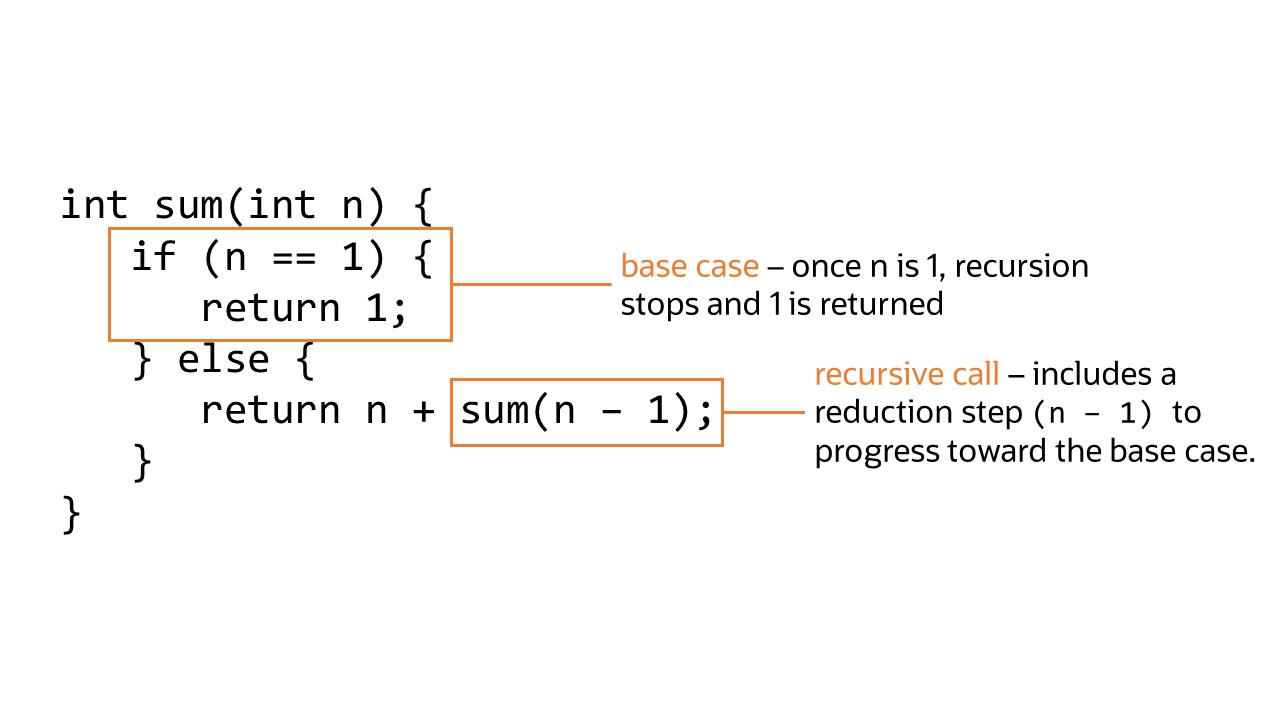
Recursion happens when a method calls itself. This is a repetitive process that continues and progresses until a base case is reached.
There are two critical parts to a recursive method.
- A base case.
- A recursive call with a progression toward the base case.
Without a proper progression towards the base case, the code could result in infinite recursion. This is where the program continues to call the recursive method without a stopping point.
Writing Recursion
- Step 1: Determine the base case. The smallest case where the result is defined.
- Step 2: Break the problem down into smaller pieces. Where is this solution dependent on the solution of the next smaller problem? This is your recursive case.
- Step 3: Generalize the recursion. Be sure you avoid infinite recursion by progressing toward the base case.
- Step 4: Write your method.
Factorial Example
The factorial of a number, written as n!, is the product of all positive integers from 1 to n.
For example:
5! = 5 * 4 * 3 * 2 * 1
4! = 4 * 3 * 2 * 1
3! = 3 * 2 * 1
2! = 2 * 1
1! = 1
Step 1: Determine the base case
The base case is the simplest version, which is 1! since it has a defined value, which is 1.
Step 2: Break down the problem
5! = 5 * (4 * 3 * 2 * 1) or 5 * 4!
4! = 4 * (3 * 2 * 1) or 4 * 3!
3! = 3 * (2 * 1) or 3 * 2!
2! = 2 * (1) or 2 * 1!
1! = 1 --- the base case
Step 3: Generalize the recursion
In general: n! = n * (n - 1)!
The generalized recursive call, progresses toward the base case of 1 by repeated subtracting 1.
Step 4: Write your method
Check for the base case:
- if the parameter passed represents the base case, return the defined value.
- if the parameter passed is not the base case, return a value with the recursive call progressing towards the base case.
Consider this example of recursion for computing a sum:
To write the factorial method, we will:
Check to see if the parameter n is 1:
- if it is,
return 1 - else, `return n * factorial(n - 1)